

Science simulations have become an increasingly useful part of modern science teaching. They allow pupils to explore experiments, test ideas, manipulate variables and observe scientific processes in ways that can complement practical laboratory work.
For some learners, simulations can also provide an important alternative when a physical experiment is difficult to access. This can be particularly relevant in special Education settings, Alternative Provision, home education and schools where equipment, laboratory time or specialist support may be limited.
Below are 10 science simulation platforms that teachers and educators can explore.
1. ClassAdapt

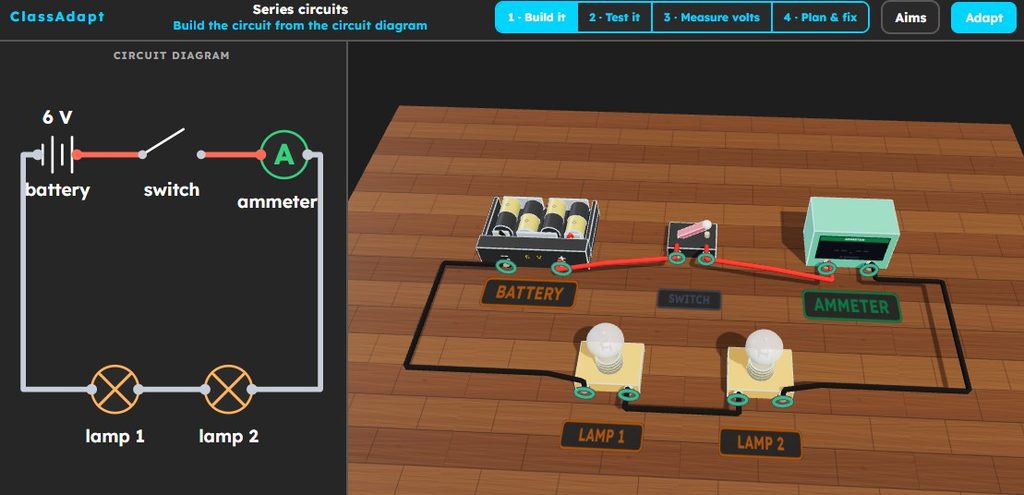
ClassAdapt is a SEND-first learning platform focused on making GCSE Science more accessible featuring virtually all GCSE topics in Physics and Chemistry although the platform would for some reason prefer to place emphasis on their practical science simulations.
The platform provides hundreds of interactive simulations designed around GCSE science topics in Physics and Chemistry, including required practicals in Physics and Chemistry. Students can work through practical activities digitally, follow structured guidance, collect and interpret data and develop familiarity with experimental procedures.
One of ClassAdapt’s distinctive areas is accessibility. The platform has been designed with learners who may experience barriers to conventional science learning in mind. Features include text-to-speech, dyslexia-friendly options, colour-vision support, reduced motion and accessible navigation.
ClassAdapt also combines simulations with digital and printable learning resources. Its Smart Test feature allows teachers to create assessments that are automatically marked, providing instant feedback while reducing the amount of marking teachers need to do.
This makes ClassAdapt particularly relevant to GCSE Science teachers, SEND departments, Alternative Provision, tutors and home educators looking for structured practical science activities.
2. PhET Interactive Simulations


PhET Interactive Simulations from the University of Colorado Boulder is one of the best-known collections of interactive science simulations.
PhET provides simulations covering Physics, Chemistry, Biology, Earth Science and Mathematics. Many are free to use and are designed to allow learners to manipulate variables and observe the resulting changes.
For example, Physics simulations can allow students to investigate forces, circuits, waves, energy and motion without requiring physical laboratory equipment.
A major strength of PhET is its flexibility. Teachers can use individual simulations as demonstrations, starter activities, investigations or independent learning tasks.
3. Labster
Labster focuses on immersive virtual laboratory experiences.
Rather than simply displaying an interactive model, Labster places students in virtual laboratory environments where they can perform experiments and make decisions as part of a scientific investigation.
The platform covers areas including Biology, Chemistry, Physics and Environmental Science.
Virtual laboratories can be particularly useful where schools want students to experience laboratory procedures but have limitations relating to equipment, cost, safety or laboratory availability.
Labster is also widely used in further and higher education, making it relevant for students progressing beyond GCSE.
4. ExploreLearning Gizmos
ExploreLearning Gizmos provides a large collection of interactive STEM simulations for school learners.
The platform combines simulations with lesson materials, investigations, assessments and teacher resources.
Gizmos covers subjects including Physics, Chemistry, Biology and Earth Science. Students can manipulate variables, collect data and investigate scientific relationships.
For teachers, the combination of simulation and classroom resources can make it easier to incorporate digital experimentation into an existing lesson sequence.
5. Concord Consortium
Concord Consortium develops research-based digital learning resources, models and simulations for STEM education.
Its resources often focus on scientific inquiry rather than simply demonstrating a scientific concept. Students can manipulate models, investigate relationships and use evidence to develop explanations.
The platform covers areas including Physics, Chemistry, Biology and Earth Science.
This makes Concord particularly relevant for teachers who want students to develop scientific reasoning and modelling skills alongside subject knowledge.
6. ChemCollective
ChemCollective specialises in virtual chemistry laboratories.
Students can work with virtual chemicals and laboratory equipment and carry out experiments that would otherwise require a physical laboratory.
Its resources include activities involving areas such as titration, thermochemistry, solubility and redox chemistry.
For Chemistry teachers, virtual laboratories can provide an opportunity for students to practise experimental thinking before, after or alongside physical practical work.
7. HHMI BioInteractive
HHMI BioInteractive provides a wide range of Biology resources, including interactive activities, virtual laboratory experiences, videos and classroom materials.
Many of its resources are based around real scientific research and allow students to explore biological concepts using authentic data and scientific scenarios.
The platform is particularly useful for Biology teachers looking to connect classroom learning with real scientific investigations.
8. CK-12
CK-12 provides free digital educational resources across Science and Mathematics.
Its science resources include interactive simulations and activities that allow students to explore concepts visually and experimentally.
CK-12 covers subjects including Physics, Chemistry, Biology and Earth Science.
The platform can be useful for teachers looking for free digital resources that can supplement textbooks and conventional classroom instruction.
9. LabXchange
LabXchange is a free science education platform developed by Harvard University.
It combines interactive learning resources, simulations, virtual laboratory activities and structured learning pathways.
Rather than focusing exclusively on individual simulations, LabXchange can be used to build broader learning experiences around scientific topics.
This can be useful when teachers want to combine videos, simulations, questions and other digital resources within a single learning journey.
10. PraxiLabs
PraxiLabs provides 3D virtual laboratory experiences.
Students can interact with virtual laboratory equipment and conduct experiments in a simulated environment.
The platform covers scientific subjects including Chemistry, Biology and Physics and is designed to give learners opportunities to practise laboratory procedures digitally.
Virtual laboratories such as PraxiLabs can be particularly valuable when physical laboratory access is restricted or when teachers want students to familiarise themselves with an experiment before conducting it in person.
Why Science Simulations Matter
Science simulations should not necessarily be viewed as a replacement for physical practical work. Physical experiments provide experiences that a screen cannot completely reproduce, including handling equipment, managing materials, working safely in a laboratory and collaborating with other students.
However, simulations can complement physical practical science in several important ways.
Students can repeat an experiment without consuming materials. They can make mistakes without damaging equipment. Teachers can use simulations before a practical to introduce the procedure, or afterwards to reinforce the concepts and data analysis.
For learners who need additional scaffolding, simulations can also provide more time and control. A pupil can repeat a procedure, review instructions and work at a pace that may not be possible during a busy laboratory lesson.
This is particularly relevant to inclusive science education.
Choosing the Right Simulation Platform
There is no single platform that will meet every teacher’s needs.
A Physics teacher may want a concept simulation for forces or electricity. A Chemistry teacher may need a virtual laboratory. A Biology teacher may want to analyse authentic research data.
The curriculum also matters. GCSE teachers may prioritise required practicals, examination preparation and data analysis, while university educators may require more sophisticated laboratory environments.
Accessibility is another important consideration. A simulation can be scientifically accurate and visually impressive while still presenting barriers for some learners.
For this reason, teachers should consider not only what a simulation teaches, but also who can access it and how easily it can be integrated into the lesson.
The Future of Digital Practical Science
Digital simulations are becoming an increasingly useful part of science education.
The most effective approach is likely to be a combination of physical practical work, digital simulations, structured guidance and assessment.
For schools supporting learners with SEND or limited access to laboratory facilities, this combination can be particularly valuable.
Platforms such as PhET, Labster, Gizmos, ChemCollective and LabXchange demonstrate the breadth of what is now possible with digital science learning.
ClassAdapt approaches the opportunity from a more specific direction: making GCSE practical science more accessible to learners who may face barriers to conventional practical work.
Ultimately, the goal of science simulation technology is not simply to put an experiment on a screen. It is to help more students understand, practise and engage with science.
That is where digital practical science has the potential to make a meaningful difference in the classroom.
Read our disclaimer.
AD: Take Free online baptism course: Preachi.com


Free Science simulations at Classadapt (UK) Classadapt.com