

Stoplearn.com reports on a recent poll by Dylan Wiliam exploring a fundamental question about teacher professional development: how much can students’ learning improve when teachers receive 25 hours of high-quality professional development focused on the science of learning?
The poll asked:
“How much faster will students learn if their teachers are given 25 hours of high-quality professional development on the science of learning?”
We checked the poll after it closed on 3 October 2026, when it had received 840 votes.
What did people predict?
The results were:
- 39.8% said less than 10%
- 18% said 10% to 15%
- 14.4% said 15% to 20%
- 27.9% said more than 20%
How much faster will students learn if their teachers are given 25 hours of high-quality professional development on the science of learning?
— Dylan Wiliam (@dylanwiliam) September 27, 2026
The results show a fairly wide range of expectations. While the largest group selected less than 10%, more than a quarter of respondents selected more than 20%.
However, the poll measures expectations, not the actual effect of professional development on student learning.
That distinction matters.
What happens after the training?
The poll prompted a further discussion about how the impact of professional development should be understood.
Under the same thread, ClassAdapt asked Dylan Wiliam:
“Would the more important question be not simply how much faster students learn, but which specific teacher practices change after the 25 hours, and how do we measure whether those changes actually translate into durable learning gains?”
Dylan responded:
“I think that is a secondary question, related to the optimization of an intervention. The first question is whether the intervention is worth doing in the first place.”

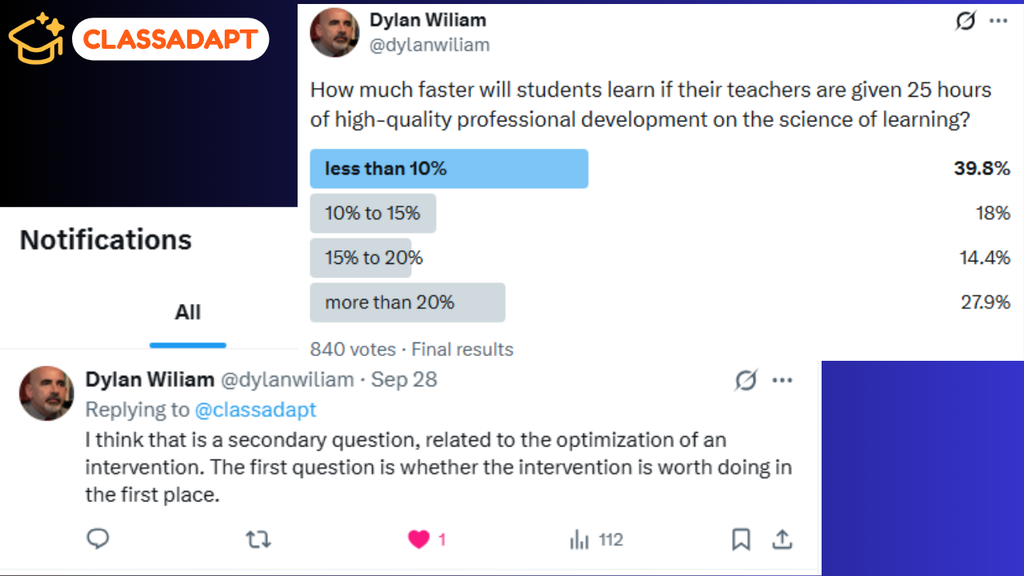
His response brings the discussion back to a more fundamental issue.
Before looking at how professional development can be improved or optimised, schools need to establish whether the intervention itself produces a meaningful improvement in student learning.
Measuring the impact of professional development
For schools, this could be particularly important because professional development involves more than the direct cost of a training programme.

.png)
Read our disclaimer.
AD: Take Free online baptism course: Preachi.com


Free Science simulations at Classadapt (UK) Classadapt.com
Twenty-five hours represents a significant investment of teachers’ time. Schools therefore need to consider what they are getting from that investment.
If professional development is intended to improve learning, one useful way of evaluating it could be to look at the different stages between the training and the eventual outcome.
For example:
Professional development → teacher knowledge → classroom practice → student learning → long-term retention
A change at one stage does not necessarily guarantee a change at the next.
Teachers may learn new ideas without substantially changing their classroom practice. A change in classroom practice may also produce an immediate improvement without necessarily resulting in stronger long-term retention.
This is why questions about durable learning gains become important once an intervention has been shown to be worthwhile.
What changes in the classroom?
If 25 hours of professional development does make a meaningful difference, the next question could be what teachers actually do differently.
Does professional development lead to changes in:
- questioning?
- formative assessment?
- retrieval practice?
- feedback?
- explanation?
- lesson sequencing?
- identifying misconceptions?
- adapting teaching to pupils’ needs?
And are those changes still visible months later?
These questions can help connect professional development to what students actually experience in the classroom.
For schools, the ultimate issue is not simply whether teachers completed 25 hours of training. It is whether that investment results in better teaching and better learning.
A question worth investigating
The Stoplearn.com view is that Dylan Wiliam’s poll provides an interesting starting point for a much wider discussion.
The poll tells us what respondents expected. It does not establish that students will actually learn 10%, 15% or 20% faster following 25 hours of professional development.
That would require evidence from an intervention and appropriate measures of student learning.
The question then becomes broader:
How should schools measure the return on investment from professional development?
Should they focus on teacher knowledge, changes in classroom practice, assessment outcomes, retention over time, or a combination of these?
And perhaps most importantly, how long should schools wait before deciding whether an intervention has genuinely worked?
For schools investing significant time and resources in professional development, these questions are worth examining alongside the training itself.
What would you measure to determine whether 25 hours of professional development was actually worth the investment?
Read our disclaimer.
AD: Take Free online baptism course: Preachi.com
Free Science simulations at Classadapt (UK) Classadapt.com