 StopLearnStopLearn
Solar charge controllers are indispensable in a solar power system installation. The solar panel generates electricity, but the problem here is that the power generated by the solar power is not regulated. This electrical power goes straight into the battery and without regulation, it will over charge the battery and damage it.
So the solar charge controller is the device that stands in between the solar panels and the batteries. This device is also intelligent. It senses when the battery is fully charged and it stops feeding in current into the battery at this stage. So you see why I started by saying that the solar charge controller is indispensable?
At this point I must say that charge controllers are not really needed for smaller systems like 5W or so.
There are two main types of solar charge controllers. They both do the job. See below the types and their respective merits and demerits.
.png)
Read our disclaimer.
AD: Take Free online baptism course: Preachi.com 
Free Science simulations at Classadapt (UK) Classadapt.com
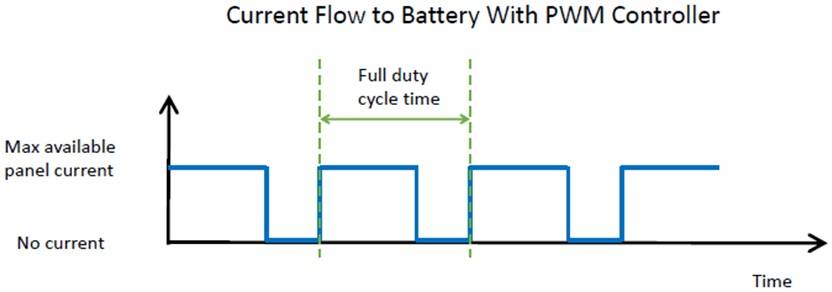
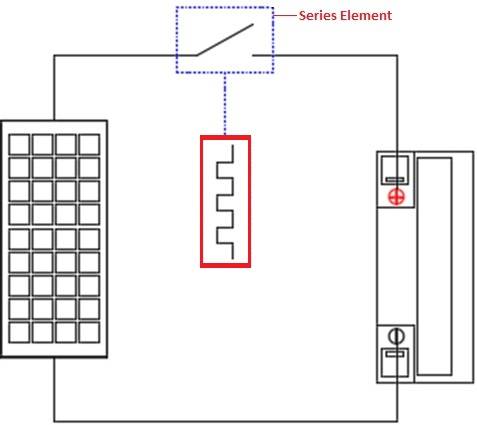 Like the series regulator, the transistor can be placed in either the positive or negative line, allowing the regulator to be used in positive and negative ground systems.The difference between the series regulator and the PWM regulator is the PWM of the transistor. When the modulation width is at 100% or 0%, the regulator is essentially a series regulator, it is that modulation width variation that allows the PWM regulator to create a constant voltage to the battery as opposed to the on/off of the series regulator. The below figure shows an example of a PWM regulator regulating with a 70% on 30% off duty cycle.
 Some PWM regulators have provisions for converting to a series (on/off) regulator. This could be needed for sensitive loads that have an issue with the noise created by the frequency of the PWM. Some PWM regulators have provisions for converting to a series (on/off) regulator. This could be needed for sensitive loads that have an issue with the noise created by the frequency of the PWM. Because PWM charge controllers require transistors, they are always solid-state; this means heat dissipation can become a problem, especially in larger solar arrays.As with series regulators, because the PWM regulator regulates by opening the array during regulation (at high frequency), if you were to measure the array voltage during this time, the array voltage can be anywhere between battery voltage and open circuit voltage depending on the regulator’s charging stage. If an array voltage value less than the battery voltage was ever measured during normal operation, this would indicate a problem.
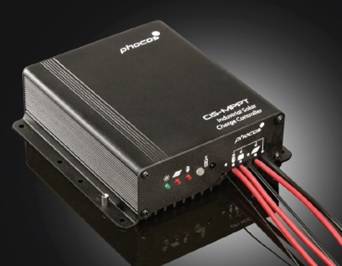 Since MPPT charge controllers can vary the charge current to the battery, the regulator can be a multi-stage charger with bulk, absorption, and float settings. They are always solid state; this means heat dissipation can become a problem, especially in larger solar arrays. MPPT controllers are typically step-down converters, so the array voltage always needs to be higher than the battery voltage. Therefore, an array voltage value less than the battery voltage during normal operation would indicate a problem.
Which one? MPPT or PWM Solar charge controller?
I introduced Michael earlier on and he is here once again to let you understand the difference between the two types of charge controllers and which one you should go for.
Now watch the summary of the entire lesson before you proceed to next class.
Read our disclaimer.
AD: Take Free online baptism course: Preachi.com
Free Science simulations at Classadapt (UK) Classadapt.com