 StopLearnStopLearn
Production of Tie and Dye
Just as the name implies, tie and dye is the tying of portions of clothes to prevent dye from penetrating some parts of the fabric. It involves tying a cloth to any pattern and dipping it in dye and when you bring it out, wash and loose the tied part and designs are formed.
Making of Tie and Dye
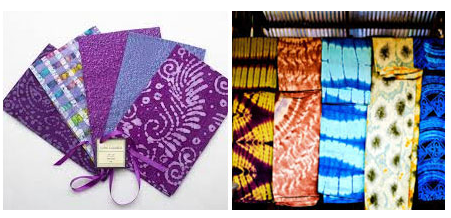
Materials for Tie and Dye
Twine, rubber, rope, needles, pencils, polythene, cloth pegs, clips, stones, pebbles, safety pin, plastic basins and buckets, hand gloves, stick, spoons, etc.
Methods:
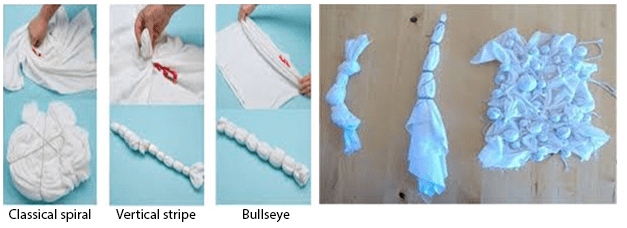
Procedure for Making Tie and Dye
Dyeing Process with Vat Dye
(i) Destarching: Washing the fabric in cold or hot water but without soap, allow things that may prevent the dye from penetrating the fabric to wash off.
(ii) Mixing of the chemicals with hot water that covers the fabric:
| Material/ Yardage | Hydrosulphite (Germany) | Caustic Soda | Hydrosulphite (China) | Caustic Soda | Dye | |
| 1 yard | 1 Tsp (Table spoon) | ½ Tsp | 2 Tsp | 1 Tsp | 1 Tsp | |
| 2 yards | 2 Tsps | 1 Tsp | 4 Tsps | 2 Tsps | 2 Tsps | |
| 3 yards | 3 Tsps | 1 ½ Tsps | 6 Tsps | 3 Tsps | 3 Tsps | |
| 4 yards | 4 Tsps | 2 Tsps | 8 Tsps | 4 Tsps | 4 Tsps | |
| 5 yards | 5 Tsps | 3 Tsps | 10 Tsps | 5 Tsps | 5 Tsps | |
(iii) Untying: Remove from the solution, rinse off all the running colour, lose the knots with razor blade or scissors. Rinse again, starch, and dry.
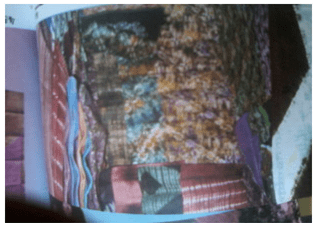
Production of Batik Fabrics
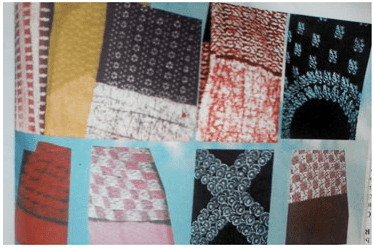
Batik method is a style of dyeing cloth/fabric where paraffin wax or candle wax is used as a resist. Designs are applied with the melted wax, of which wherever wax is applied on fabric, that area will not absorb dye.
Ways of Applying the Wax
1. Stamping Method: This involves cutting a design on a flat foam or plywood. Dip the design in a hot wax and stamp on the fabric with the arrangement you desire
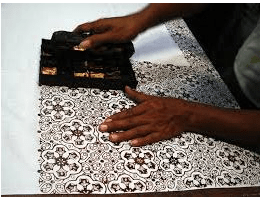
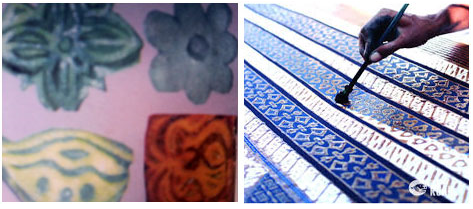
Place the cut stencil on the fabric and dab the hot wax on the stencil with the aid of foam. Repeat as you desire.
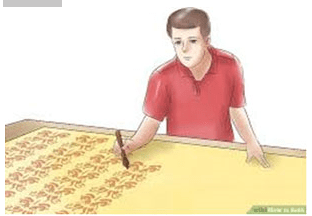
Materials: Paraffin wax or candle wax, frying pan or pot, stove, tracing paper, drawing pin,5B,6B,7B pencils, biros, brushes, foam, Tjanting pen, plastics bowl, pressing iron, mask apron, rubber gloves, etc.
Fabrics: Brocade, voile, cotton satin, lace, linen, 100% cotton, etc.
Procedure:
(i) De-starching: Washing the cloth with cold water but without soap.
(ii) Designing: After de-starching the fabric, allow to dry and apply your design on the marked out areas.
Note: The melted wax should not be very hot nor too cold.
(iii) Vatting (mixing of chemicals): E.g. 3 meters of fabric use, 2tsp of vat dye, 4Tsp of caustic soda and 5 tsps. of sodium hydrosulphite. Dissolve all the chemicals and dye with ½ glass cup of hot water and add enough cold water to cover the fabric properly. Turn with both hands using gloves. Allow to stay for about 10-15 minutes in the dye.
(iv) De waxing:
(a) Take the dyed clothe out from dye solution and wash with clean water.
(b) While still wet, dip in the hot water. Make sure that inside your hand gloves are filled with cold water.
(c) Turn the fabric very well and make sure the wax is gone off.
(d) Bring out and put the fabric right inside cold water.
(e) Squeeze out the remaining wax, wash in clean water and dry.
EVALUATION
ACTIVITY
Read our disclaimer.
AD: Take Free online baptism course: Preachi.com 
Free Science simulations at Classadapt (UK) Classadapt.com